
Konverta Lab · Free virtual shelf test
Will shoppers see your pack on shelf?
Your pack gets about two seconds on shelf, and in our demo one in three shoppers never see it. The Shelf Test runs 1,000 synthetic shoppers past your pack, your shelf, your shopper materials and the aisle, and tells you what to fix. Free, in seconds.
Sign in with a one-click email link. No password, no card. Test one pack of your own each week.
01 What it tests
Four steps, one shopper journey
-
01
Pack design check
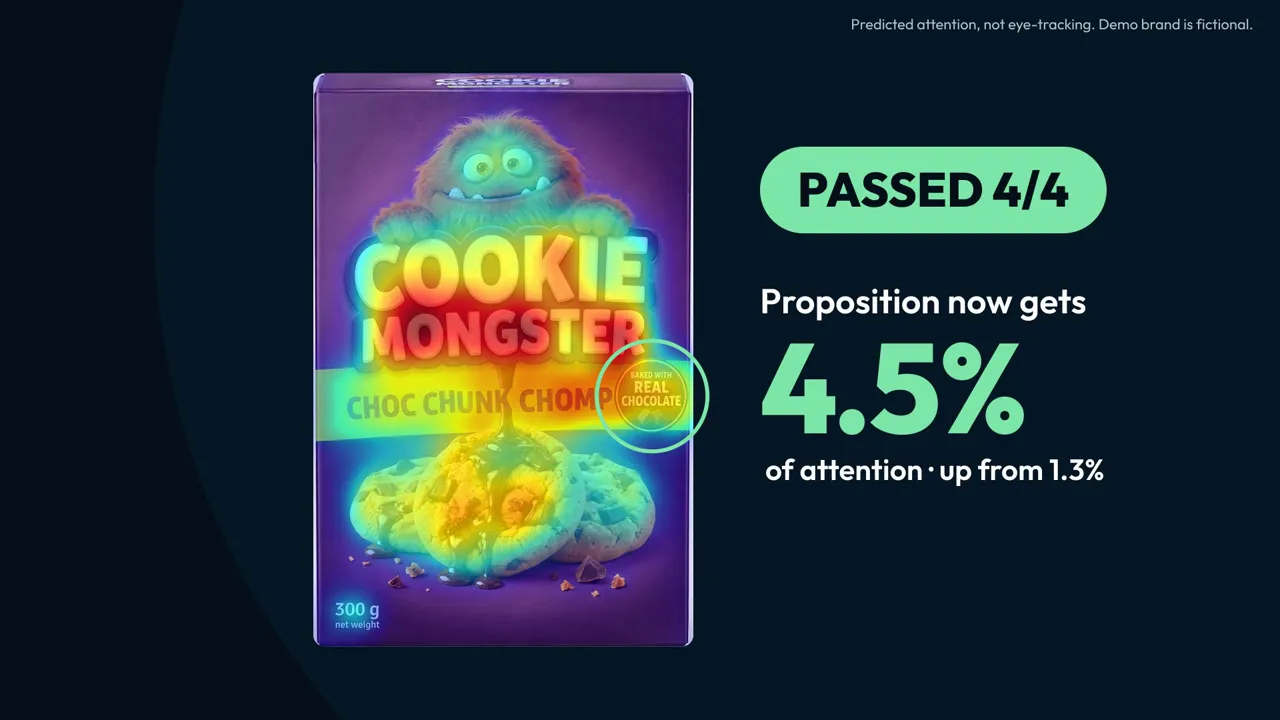
An attention heatmap and fog show where the eye goes on the pack. Four checks follow: the brand leads, the strongest area is a brand cue, the flavour gets read, and the proposition earns its space.
In the demo the small-print claim "Baked with real chocolate" gets 1.3% of attention and fails. Redesigned as a seal with chocolate poured on the cookie, it gets 4.5% and the pack passes 4 of 4.
-
02
Shelf visibility against competitors
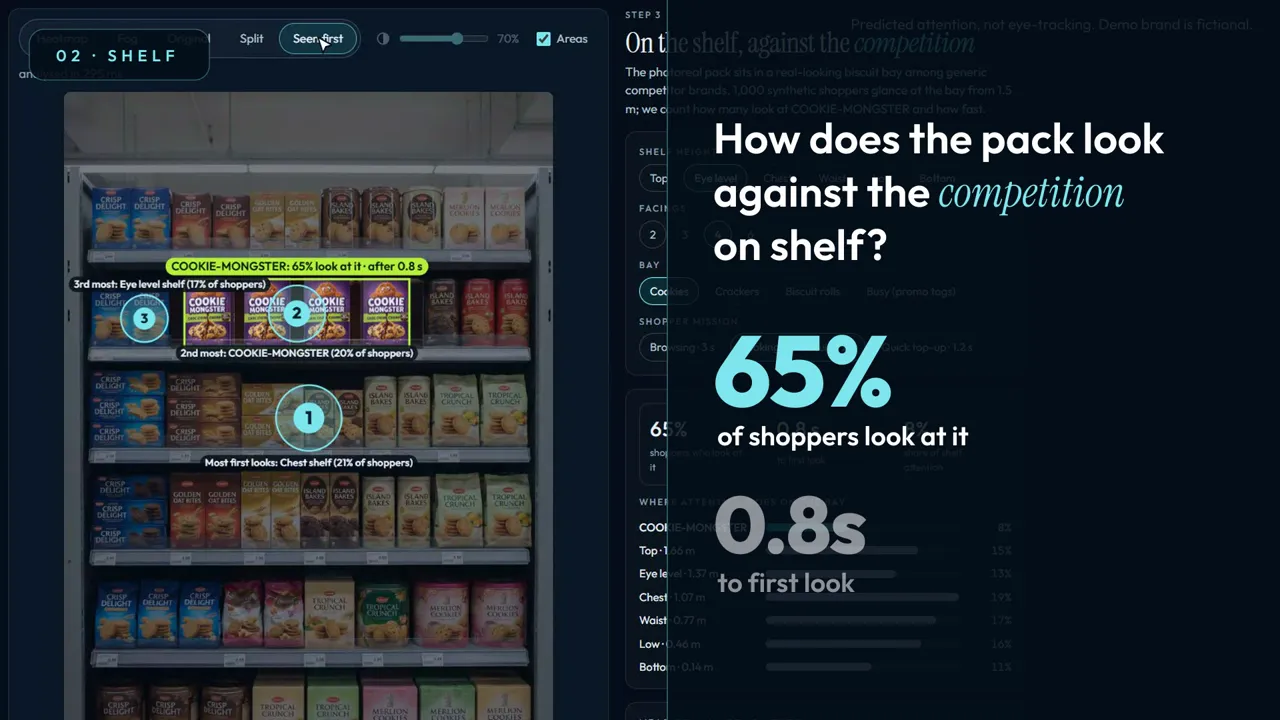
The pack goes onto a photoreal supermarket bay among competitor brands, at the shelf height and number of facings you choose. 1,000 synthetic shoppers glance at the bay and the test counts how many notice your pack, and how fast.
The redesigned demo pack: 65% of shoppers notice it, 0.8 s to first look.
-
03
Incremental attention from shopper materials
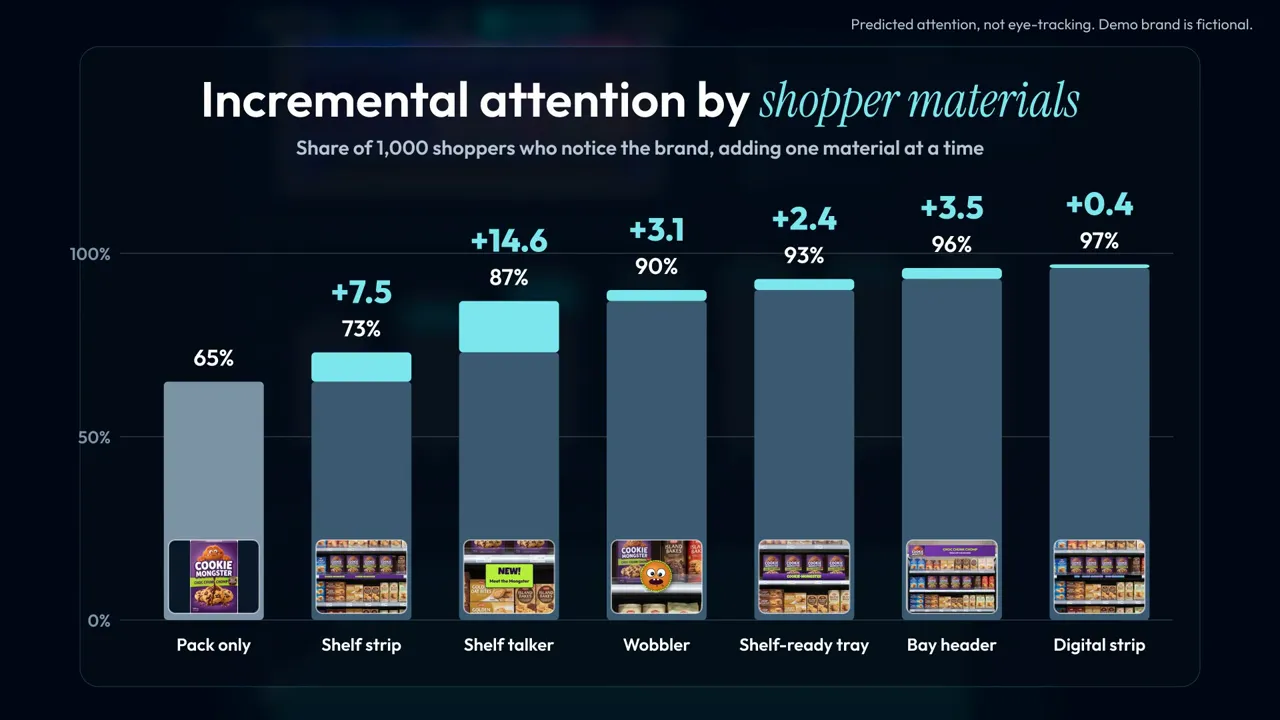
Add point-of-sale materials one at a time: shelf strip, shelf talker, wobbler, shelf-ready tray, bay header and digital shelf-edge strip. The shoppers are re-run at every step, so you see the incremental attention each one adds, and which earn their cost.
In the demo the shelf talker adds +14.6 points; the digital strip adds +0.4.
-
04
Aisle walk-by and placement decisions
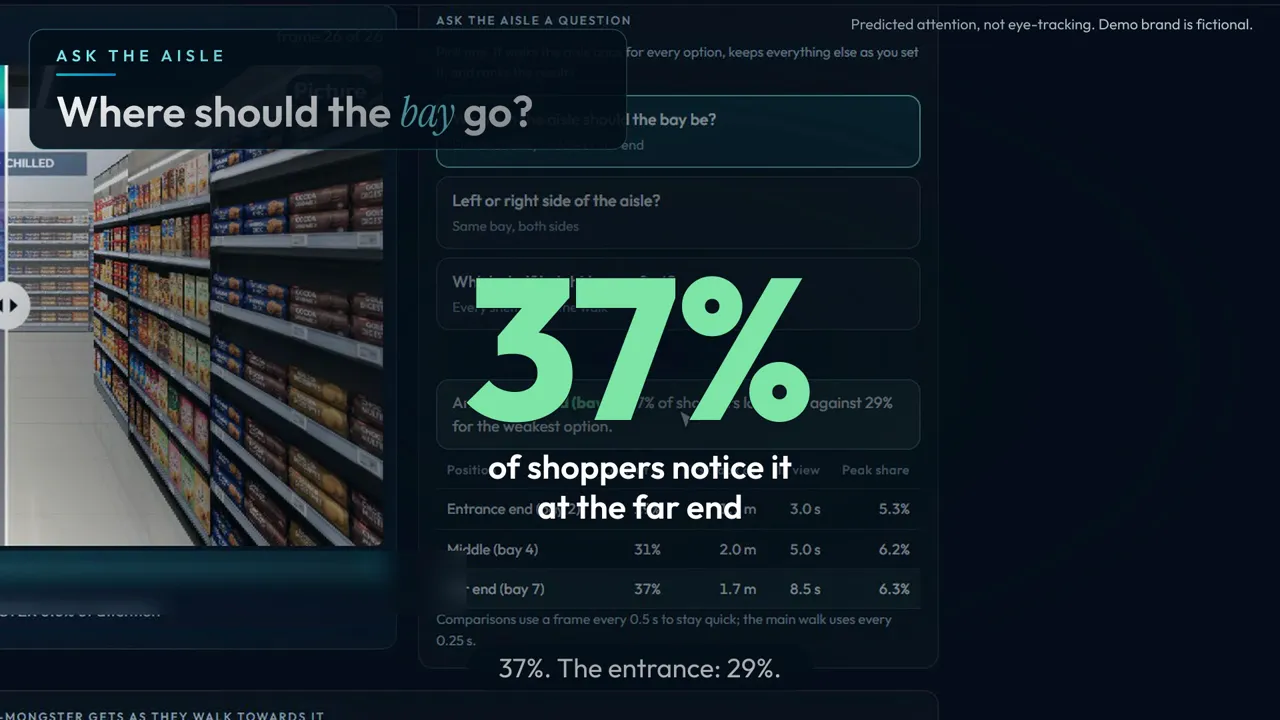
Shoppers walk the aisle and the view is scored every quarter second. Then ask a placement question, such as where in the aisle the bay should go, and get a straight answer.
In the demo: far end 37% vs entrance 29% of shoppers notice the pack.
02 Methodology
How 1,000 synthetic shoppers work
- Engine
Computer vision predicts attention
A saliency model blends four published signals (spectral residual, colour and brightness contrast, frequency-tuned saliency and text detection) to predict where the eye is pulled at first glance.
- 1,000
Shoppers who are not clones
Half women, half men, with eye heights from about 1.35 to 1.80 m. Each gives the shelf 70% to 130% of the mission time and, in the aisle, walks at their own pace. Each makes a look about every quarter second, led by predicted attention.
- ±3
Why 1,000 matters
With 1,000 shoppers, "65% notice it" is precise to about ±3 points. So a gap of more than 3 points between two options is real, not noise. The runs are seeded: the same settings always give the same answer.
This is the precision of the simulation, not its accuracy against real shoppers. The engine predicts visual attention; it does not read words or recognise faces, and the demo brand is fictional. The full methodology, step by step, is inside the tool once you sign in.
03 When to use it
Virtual shelf test vs eye-tracking
| Shelf Test (synthetic shoppers) | Eye-tracking shelf test | |
|---|---|---|
| What it measures | Predicted attention: where the eye is pulled, who notices, how fast | Measured eye movements of real shoppers |
| Time and cost | Seconds, free in the Lab | Weeks, recruitment and fieldwork |
| Options you can try | As many as you like: designs, shelf heights, facings, materials, aisle positions | A handful per study |
| Best for | Screening early, catching problems, comparing options | Validating the final decision |
Use the Shelf Test to narrow ten ideas down to two, then put the two in front of real shoppers.
04 Questions
Shelf test FAQ
What is a virtual shelf test?
A virtual shelf test shows your pack on a realistic shelf next to competitors and measures whether shoppers notice it, how fast, and what on the pack they look at. Traditional shelf tests recruit shoppers and use eye-tracking; this one uses predicted attention and 1,000 synthetic shoppers, so it runs in seconds and costs nothing.
Is the Shelf Test free?
Yes. Sign in with your email (a one-click link, no password or card) to use the full demo, and test one pack of your own each week, free.
How do the 1,000 synthetic shoppers work?
Each synthetic shopper starts looking at their own eye height and makes a fixation about every quarter second, choosing where to look in proportion to predicted attention, preferring short eye movements and not returning to spots already seen. They differ in eye height (women and men, about 1.35 to 1.80 m), in how long they give the shelf (70% to 130% of the mission time) and, in the aisle, in walking pace. A shopper notices the pack if any fixation lands on it.
Why 1,000 shoppers?
With 1,000 runs, a result like "65% of shoppers notice the pack" is precise to about ±3 points (95% confidence). With 300 runs it would be about ±5. So a gap of more than about 3 points between two options is a real difference, not noise. This is the precision of the simulation, not its accuracy against real shoppers.
Is it as accurate as eye-tracking?
No. It predicts bottom-up visual attention; it does not read words, recognise faces or know a brand. Use it to screen designs, shelf positions and shopper materials early and cheaply, then validate the big decisions with eye-tracking or shopper research.
Which shopper materials can I test?
Shelf strip, shelf talker, wobbler, shelf-ready tray, bay header and digital shelf-edge strip on the shelf, plus an aisle blade and floor graphic in the aisle walk-by. Each is added one on top of the next, so you see the incremental attention each one adds.
Can I put my own product on a real shelf?
The free demo lets you upload your own pack art each week. Putting your products on your real shelves, against your real competitors and with your shopper materials, is a custom build for your category. Email [email protected].
Just need a quick read on one pack, ad or poster? Try the free attention heatmap. Curious how this started? Read Can AI synthetic shopping tell you which shelf a shopper picks?
Want real shopper insights on your real products?
Your packs on your shelves, against your competitors, with your shopper materials. Built for your category.