
AI · 13 min read
Data for AI · Part 2
AI for business intelligence: the semantic layer, your data's interpreter
The AI layer most people miss, and wonder why AI interprets their data differently every time: the Semantic Layer (your interpreter).
In short In AI for business intelligence, the semantic layer is the interpreter for your data. Your sales system, finance, dashboards and AI tools each speak their own language. The interpreter sits in the middle and writes down one meaning: how your metrics connect, what each number means for the business, who is who and what is what. Build it once, and every person, tool and AI hears the same thing. It is the layer most AI projects skip.

- Published
- Last updated
Key takeaways
- AI for business intelligence fails quietly when the numbers are right but nobody wrote down what they mean. That is the whisper chain.
- The semantic layer is the interpreter: one written meaning for how metrics connect, what each number means for the business, who is who and what is what.
- Structured and unstructured data go through one layer, not two.
- Described data helps: GPT-4 went from 16% to 54% correct in a 2023 benchmark.
- Start with one use case. For an SME, the first semantic layer is one page of plain English.

Remember the whisper game from school? One person whispers a message to the next. By the end of the line, the words have drifted and nobody agrees what was meant.
Your business data plays a quieter version. The numbers are right. What they mean gets lost between systems.
Take your 200g pack, one month (illustrative). Revenue is down 5%. Brand awareness is up 10%. The pack is now stocked in 70 of 100 stores, down from 80.
You roll out AI for business intelligence and ask, "Did marketing work?" Three times. You get three answers:
- "Marketing failed, cut the budget."
- "Brand is building, sales will follow."
- "It's price, run a promotion."
Every number was right. The meaning wasn't written down. Sales tells one story, the brand tracker another, the store list a third, and the AI has to guess how they fit together. The AI isn't broken. You didn't build your interpreter.
The interpreter is the semantic layer. It writes down, once, how your numbers connect. For example (illustrative; your rules will differ):
- Sales = stores stocking it × sales per store.
- If sales per store are up, demand is fine.
- Revenue down and distribution down means check the shelf before you blame the brand or the price.
With it, the AI gives one answer, every time: "Awareness is up and sales per store are up 9%. Revenue fell because 10 stores stopped stocking the pack. Demand is holding, so marketing isn't the problem. Fix distribution."
Here is the arithmetic. Last month, 80 stores sold 35 packs each: 2,800. This month, 70 stores sold 38 each: 2,660. That is 5% down in total, while each store sells about 9% more. Shoppers in the stores that still stock it are buying more, not less. The fix is the shelf, not the price or the budget. Anyone in sales spots that in seconds. The AI can't, unless someone writes it down.
I see this often in marketing teams that have just rolled out a "chat with your data" tool. This piece is for the leaders paying for those tools, not the engineers building them. Every example is illustrative. This is Part 2 of my Data for AI series: Part 1 was about tagging, and Part 3 is about the token cost of messy data.
Why does AI give different answers to the same question?
AI gives different answers because it doesn't know how your metrics connect or what they mean for the business, so it guesses a new story each time. AI assistants and large language models (LLMs) are good at language, not at knowing your business rules.
Look back at the three answers. Each is a fair reading of the same correct numbers. One reads revenue alone. One reads awareness alone. One assumes price. None checks sales per store, or knows that sales depend on how many stores stock the pack.
Customers are the same. Your newsletter list has "Sam". Your website has "visitor 4821". Your CRM has "S. Tan". To a machine, that is three strangers.
Guess differently, answer differently. That is the whisper chain: every step re-reads the meaning for itself. The fix is not a bigger model. It is one interpreter that everyone listens to.
Why do AI BI tools give wrong answers from the right numbers?
AI BI tools usually go wrong because they read correct numbers without knowing how they connect. When people say the AI gave "wrong numbers", the data is usually fine. The interpretation is not.
The tool reads revenue without distribution. It treats a dip after losing stores like a dip after a price rise. It never checks whether sales per store went up. Each is another whisper in the chain.
Here is the difference an interpreter makes:
| Question or situation | BI without a semantic layer | BI with a semantic layer |
|---|---|---|
| "Did marketing work?" | Three answers, depending on which number the AI reads first | One answer, from written rules on how metrics connect |
| Revenue down, distribution down | "Cut the price" or "cut the budget" | "Check the shelf before you blame the brand or the price" |
| Awareness up, revenue down | "Marketing failed" | "Sales per store are up, so demand is fine" |
| Same question, next week | May tell a different story | Same answer |
| Customer "Sam" | Three records, three strangers | One customer, C-1027 |
| Reviews and survey answers | Read separately, if at all | Linked to product, store and issue |
What is a semantic layer, in simple terms?
A semantic layer is the interpreter for your data: a shared description of what your data means and how it connects, written once and read by every tool, team and AI model.
A good interpreter does more than swap words. They know who is speaking, what each term means in this room, and how one point connects to the next. A semantic layer does the same four jobs:
- How metrics connect, and what a number means for the business. Sales = stores stocking it × sales per store. If sales per store are up, demand is fine. Revenue = price × units sold − returns. One definition everywhere.
- Who is who. "Sam", "visitor 4821" and "S. Tan" are one customer, C-1027.
- What is what. "CM-200" in sales and "the 200g pack" in a review are one product.
- How the stories connect. "My 200g pack from the Orchard store was crushed" becomes CM-200, Store X, packaging damage.
The first three are classic analytics. The fourth is new, because AI can now read reviews, survey verbatims and emails. But what it finds must go through the same interpreter as your sales data. One layer for structured and unstructured data, not two. Two interpreters means two versions of the truth, and the whisper chain starts again.
Semantic layer vs data lake, data warehouse and knowledge graph: what's the difference?
A data lake or data warehouse stores your data; a semantic layer is the interpreter that explains what it means. A metrics layer is one part of a semantic layer, and a knowledge graph is one way to build one.
| Term | What it is | The question it answers |
|---|---|---|
| Data lake | Storage for any data, meaning decided later | "Where is everything kept?" |
| Data warehouse | Storage for structured data, built for analysis | "Where are the clean numbers?" |
| Metrics layer | Business numbers defined once | "How do we calculate revenue?" |
| Knowledge graph | Things and the links between them | "How is this customer linked to this product?" |
| Semantic layer | What all the data means and how it connects | "What does this mean, and is it the same thing?" |
So, do you need a data lake first? Not to get started. A data lake is a good place to keep everything, and many growing businesses will want one. But storage and meaning are different jobs. The semantic layer works on top of whatever you have today, a few spreadsheets, a warehouse or a lake, and it is what makes that data useful to AI.
Does a semantic layer really make AI more accurate?
Yes. In one published benchmark, GPT-4 answered more than three times as many questions about company data correctly once the data was described for it.
In that 2023 benchmark on an enterprise insurance database, Juan Sequeda, Dean Allemang and Bryon Jacob found that GPT-4 answered 16% of questions about company data correctly from the raw SQL database, and 54% when the same data was described through a knowledge graph (arXiv:2311.07509). Same model, same data. The difference was giving it an interpreter.
Two more reasons it pays:
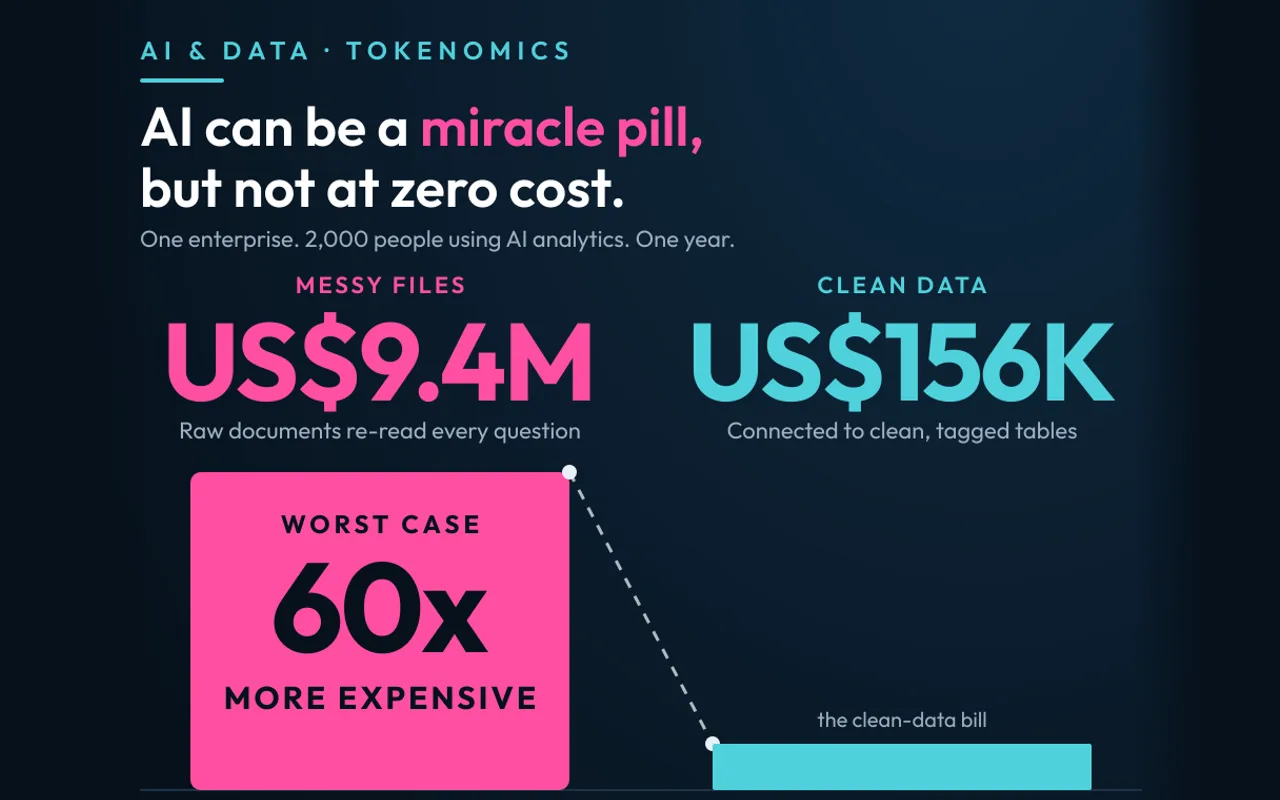
- Cost. In an illustrative example from this series, one question cost about 200,000 tokens reading raw files and about 3,000 reading a short description plus clean tables. The AI asks the interpreter instead of re-reading the whole library. Pay once, not every time you ask.
- Consistency. Meaning defined once gives the same answer today, next week and from any tool.
Can AI replace business intelligence dashboards?
Not fully. AI changes how people ask questions, but dashboards still do one job well: showing the same agreed numbers to everyone, every week.
The likely future is both. Dashboards for the numbers you track every Monday. AI for the "why" questions in between. Both work only if they read from the same interpreter. Otherwise your dashboard and your AI are just two more people in the whisper chain.
How do you make your data AI-ready without a big project?
Start small, with three rules and one use case. AI-ready data is data AI can answer from accurately and consistently.
- Clean the facts first. One customer ID, product code and store code on every record. One format for numbers, dates and units. Clear consent records (in Singapore, think PDPA) before anything is joined up.
- Process the stories on arrival. When a review or survey answer lands, AI tags it once against your fixed lists and saves the result as a row.
- Keep the originals. People want quotes, and next year brings questions nobody asked this year.
Then start from one use case, not from all your data. Something a person will act on every Monday (illustrative): "list customers who love us in surveys but haven't bought in 90 days". Write the meaning for just the two or three sources it needs. Add the next use case later. The interpreter learns one definition at a time.
For a 20-person business, the first semantic layer can be one page of plain English: the customer ID, the product and store lists, five to ten key definitions, and a fixed list of review issues. That page will do more for your AI answers than a pricier model. (See the sample below.)
For a 2,000-person enterprise, it becomes a governed layer. The hard part isn't technology. It is agreeing one definition of "active customer" across markets, naming an owner, and stopping each team or AI tool from quietly hiring its own interpreter.
Sample: a one-page semantic layer you can copy
For a 20-person snack brand selling a 200g cookie pack through 80 stores. All names and numbers are made up. Copy the shape, not the content.
Illustrative sample
Our semantic layer, v1
1. Who's who (customers)
- One customer = one email address. "Sam" (newsletter), "S. Tan" (CRM) and "visitor 4821" (website) are the same person when the email matches.
- Active customer = bought in the last 90 days.
2. What's what (products and stores)
- CM-200 = "the 200g pack" = "Cookie 200g". One product list, kept by Operations.
- Store X = "the Orchard store". One store list, kept by Sales.
- Stores stocking it = stores on the distributor report with the pack in stock that month.
3. What each number means
- Revenue = price × units sold − returns. Source: the finance system after month-end close.
- Sales per store = units sold ÷ stores stocking it.
- Brand awareness = % of people who recognise the brand when shown it. Source: the quarterly brand tracker. Quarterly only.
- Promo sales = units sold while on promotion.
4. How the numbers connect
- Sales = stores stocking it × sales per store.
- If revenue is down, check in this order: stores stocking it, then sales per store, then price, then promotions.
- Stores down but sales per store up = demand is holding. It's a distribution problem, not a brand or price problem.
- Awareness is quarterly. Compare it with sales over the same quarter, never with a single month.
5. How the stories connect (reviews and surveys)
- Every review or survey answer is tagged with: product, store, issue.
- Issue list (fixed): packaging damage, taste, price, availability, delivery, service, other.
6. Rules for any AI or dashboard
- Use only these definitions.
- If a question needs a number that isn't defined here, say so. Don't guess.
- Always state the period and the source of every number.
Five questions to ask before you buy a "chat with your data" tool
Ask where the tool gets its meaning from, because that decides whether it reads your numbers the way your business does.
- Where does the tool read what "revenue" or "active customer" means, and how metrics like sales and distribution connect? If the answer is "it works it out", expect different answers.
- If I ask the same question tomorrow, will I get the same answer? Ask them to show you.
- Can it link reviews and survey answers to the same customer and product IDs as sales?
- Who in my team owns the definitions, and how are changes signed off?
- Does it query clean tables, or re-read raw files every time I ask? The second is slower, costlier and less consistent.
All five are really one question: where is the interpreter? Every new tool you add is one more person in the whisper chain. Build the interpreter once, write it down, and let every person, tool and AI read from it. Then "Did marketing work?" gets the same answer, all the way down the line.
FAQ: what do leaders ask about AI for business intelligence and the semantic layer?
What is AI for business intelligence?
AI for business intelligence means using AI, such as large language models, to answer business questions from your company's data in plain language. Instead of building a report, you ask "why did sales fall in the west?" and get an answer. It only works well when the AI knows what your data means.
What is generative BI or conversational analytics?
Generative BI, or conversational analytics, is business intelligence you use by asking questions in plain language instead of building dashboards or writing queries. Many BI tools now include a chat feature like this. The answers are only as reliable as the definitions behind them, which is why the semantic layer matters.
Why does AI give wrong answers from my data?
AI usually gives wrong answers from your data because it guesses how your metrics connect, even when the numbers themselves are right. It doesn't know that sales depend on distribution, or that rising sales per store mean demand is fine. What looks like "wrong numbers" is a wrong reading. A semantic layer writes those links down once, for every tool.
Why do we need a semantic layer?
You need a semantic layer because AI does not know what your numbers mean for the business or how they connect, so it guesses. A semantic layer is the interpreter that tells it. That makes answers more accurate, cheaper to produce and the same every time, whichever tool or team asks.
Is a semantic layer the same as a knowledge graph, an ontology or a metrics layer?
Not quite: a knowledge graph or ontology is one way to build a semantic layer, and a metrics layer is one part of it. A metrics layer defines numbers like revenue once. A full semantic layer also covers customers, products, places and how reviews link to the rest. "Context layer" is a newer term for much the same idea.
How do I know if my data is ready for AI?
Your data is ready for AI when the same question gets the same, correct answer from any tool. Check three things: one ID for each customer, product and store; clear consent records; and written definitions for your key numbers. If those are missing, clean the facts first and keep the originals.
Do small businesses need a semantic layer?
Yes, but a small one: for an SME, the first semantic layer can be one page of plain English, owned by the founder or marketing lead. It lists the customer ID, products, stores, five to ten key definitions and review issues. In an enterprise, each definition needs a named owner and sign-off.
Notes and sources
- Sequeda, J., Allemang, D. and Jacob, B. (2023), A Benchmark to Understand the Role of Knowledge Graphs on Large Language Model's Accuracy for Question Answering on Enterprise SQL Databases, arXiv:2311.07509. GPT-4 on an enterprise insurance database: 16% correct from raw SQL, 54% with a knowledge graph describing the same data.
- Token figures (about 200,000 tokens per question on raw files against about 3,000 on clean tables) are illustrative, from Part 3 of this series, the token cost of messy data.
- All examples (Sam, S. Tan, visitor 4821, C-1027, CM-200, Store X, the 200g pack and its sales figures) are made up. No real customer or client data.
Part 2 of the Data for AI series. Part 1: if you can't sound creepy, you have a tagging problem. Part 3: the token cost of messy data.
About the author
Kenneth Phua
Founder, Konverta.ai
Kenneth Phua is the founder of Konverta.ai in Singapore, which helps marketing teams at brands, SMEs and enterprises deploy AI and get their first-party data ready for it. He has 15+ years in global and regional digital, data and AI transformation roles, including as a former global head of digital strategy and innovation, and is Fractional CXO at Replicast AI.
The newsletter
Weekly insights in digital, data and AI.
AI can be a miracle pill, but not at zero cost: the token cost of messy data
Part 3 of this series: messy files can cost up to 60x more in AI tokens than clean data. The maths, the caveats and what to fix first.
Next steps
Consulting with Konverta
Build your data's interpreter.
Want the sample one-page semantic layer? It's here, ready to copy. If you want help writing yours, at SME or enterprise scale, start with a call. See how we work in consulting.
Prefer a form? Contact us.